
Escape From Tarkov update 0.13.1.0 revolutionizes player interaction and network architecture, promising smoother, fairer raids for all PMCs and Scavs.
The servers of the unforgiving Norvinsk region went dark, as they often do, but this time it wasn't just routine maintenance. Battlestate Games was pulling the plug to implement something bigger, an update aimed at fundamentally reworking the very fabric of player interaction within Escape From Tarkov. For six long hours on that July morning, PMCs and Scavs alike were left in the lurch, their raids postponed, their loot runs put on ice. The community buzzed with anticipation and a healthy dose of skepticism—would this be the patch to finally tackle the infamous 'desync' and hit registration woes that had been the bane of many a player's existence? The answer, it seemed, lay in the technical overhaul promised by update 0.13.1.0.
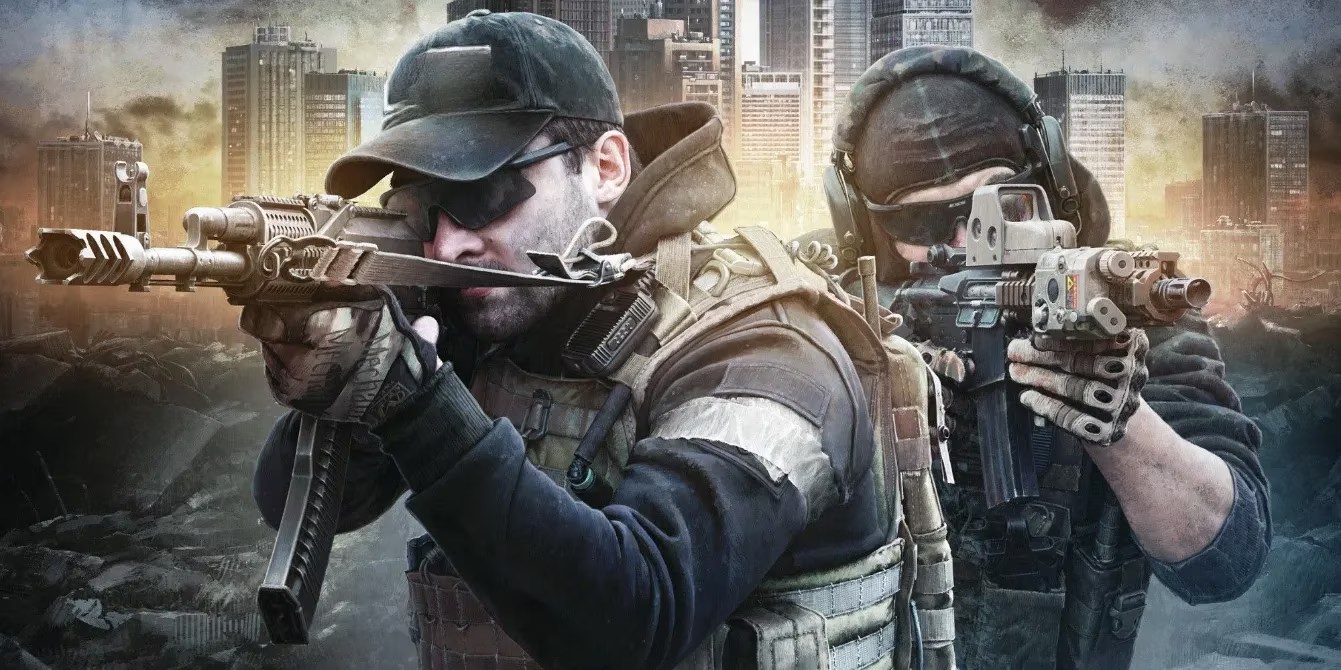
The Core: A Network Architecture Revolution
Battlestate's primary goal for 0.13.1.0 was nothing short of a revolution under the hood. The developers stated their aim was to "fundamentally change the architecture of player display and synchronization on the client and their connection to the server." In plain English? They were rebuilding how players see each other and how their actions are communicated to the game's central brain. This wasn't about adding new guns or maps; this was about making the existing brutal experience run smoother and feel fairer. The key achievements touted were:
-
Increased Raid Capacity: More network entities could now exist in a raid, specifically on the notoriously demanding Streets of Tarkov location. This was a big deal, hinting at future improvements for other maps as well.
-
Hit Registration & Positioning: Improved accuracy for both where bullets land and where players are positioned on-screen versus the server. No more shooting at ghosts!
-
Desync Reduction: A direct assault on the lag between player action and server recognition, aiming to reduce those infuriating moments of dying behind cover.
-
Optimization: Both network traffic and memory consumption were optimized, which for players often translated to fewer stutters and a more stable framerate, especially in intense firefights.
Audio Gets a Tune-Up 🎧
The sound design in Tarkov is legendary for its realism and importance. This update gave the audio systems some serious love. A major update to the Oculus Spatializer plugin fixed issues that cropped up when too many sounds played at once—a common scenario in a firefight. Weapon sounds were adjusted to be more "volumetric" while keeping precise positional audio, so you could better tell if that shot came from the left, the right, or straight ahead. They also fixed jarring transitions from mono to stereo sounds. Furthermore, the reverb effects inside buildings while wearing active headsets (like the popular ComTac or Sordin) were fine-tuned, making auditory situational awareness even more critical and realistic.
Balancing the Pain: Blacked Limbs and Blunt Force
In the gritty world of Tarkov, balance changes can mean the difference between life and a trip back to the main menu. Update 0.13.1.0 introduced two significant adjustments to damage calculation:
| Change | Effect | Player Impact |
|---|---|---|
| Reduced damage to blacked limbs by 30% | Less damage spillover from a destroyed limb to the rest of the body. | Survivability increased when a limb is already blacked out. Favors armor and meds. |
| Slightly increased blunt damage | More damage from bullets that don't penetrate armor. | Heavy armor is less of an absolute shield; sustained fire can still wear you down. |
These changes were a nod to making combat slightly less lethal in specific scenarios while ensuring that getting hit always had consequences. It was a delicate dance, and the community was quick to put these new mechanics through the wringer.
Practice Mode and a Slew of Fixes
For new players trying to learn the ropes, or veterans testing a new build, the Practice Mode received a crucial fix. The bot spawn system was reworked to be more accurate to the selected settings. No more jumping into an "offline" raid expecting a quiet stroll only to find it's a warzone because the settings didn't stick! This was part of a broader list of fixes that read like a community wishlist:
-
Visual Glitches: Fixed thermal sight signatures showing through weapons, incorrect flashlight visibility distances, and visual artifacts when changing the FOV mid-raid.
-
Performance: Optimized rendering of glass and transparent objects on Streets of Tarkov and fixed stutters caused by sound occlusion calculations in certain areas.
-
Sound Bugs: Addressed doors that incorrectly muffled or amplified sounds.
-
AI Quirks: Fixed a rare bug where bosses would freeze after throwing grenades and made it so high-reputation Player Scavs wouldn't lose standing with Fence for killing Rogue bosses.
-
Quality of Life: Stopped road decals from appearing on top of dropped loot, cleaning up the visual clutter on the battlefield.
Crucially, the developers confirmed there would be NO wipe with this update. Players could dive back in knowing their hard-earned stash and progression were safe. As the servers came back online, the real test began. Had Battlestate Games delivered a update that truly changed the feel of the game for the better? Only time, and countless brutal raids, would tell. For now, the PMCs of Tarkov geared up once more, hoping the firefights would be decided by skill and strategy, not by desync.