
Tarkov high ping kick: 250 ms ping cap keeps raids fair, but punishes far-away players.
I still remember the first time I got kicked from a Tarkov raid for high ping. It felt like being yanked out of a movie theater by an usher who refused to explain why. In 2026, that feeling has not gone away. Battlestate Games' rule—players with a ping of 250 ms or above get booted from their current game—was first announced years ago, but it remains one of the most divisive design choices in the extraction shooter genre. You get a few seconds to bring your ping down before the boot lands, so a brief network hiccup will not instantly ruin your night. But if your connection is consistently bad, or if you play from a region without nearby servers, the policy can feel less like a fix and more like a locked door.
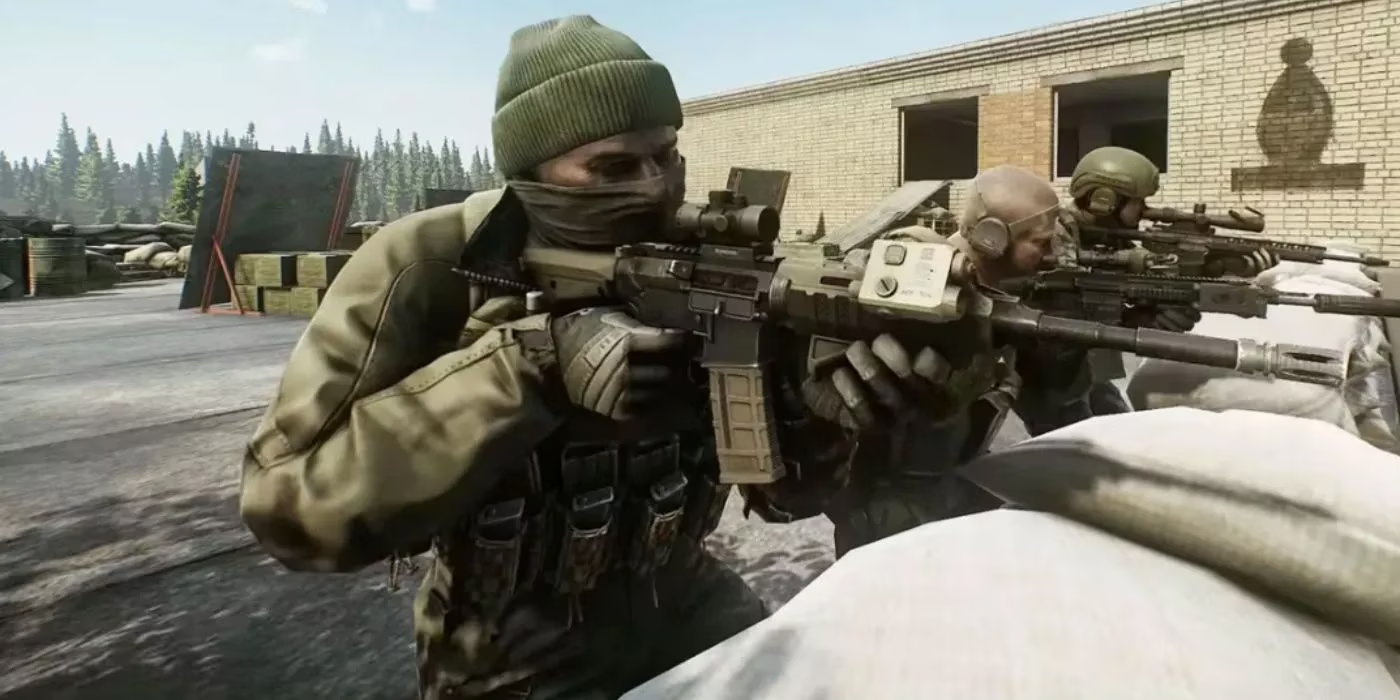
Let's be honest: high-ping players can ruin a raid. I have been on the receiving end of a teleporting PMC who seemed to be running on dial-up and prayer. Desync makes gunfights feel like arguing with a ghost. So I understand why Battlestate wanted to draw a line. A 250 ms ping cap is like trying to conduct a symphony over a satellite delay—every violin section is in a different time zone, and the conductor is just guessing. When it works, it protects the integrity of the raid. When it does not, it punishes people for geography.
The responses have been mixed, and in 2026 they are still mixed. Some players cheer because they no longer have to deal with as many lagging opponents. Others lament that they cannot play with long-distance friends anymore. And those who can only connect to servers far from home might not be able to play at all. It is a classic trade-off: competitive fairness versus global community.
Here is a quick breakdown from my own experience:
| Camp | What they say | My take |
|---|---|---|
| Anti-lag crusaders | 'Kick the teleporters. Raids feel cleaner.' | Fair. Desync is a silent killer. |
| Long-distance friend groups | 'I just want to raid with my buddy overseas.' | Heartbreaking. Tarkov is better with friends. |
| Remote-region players | 'There are no local servers. What am I supposed to do?' | This is the real problem. |
| Battlestate | 'We need a stable experience.' | True, but stability should not be a lottery. |
The sweet spot is obvious in theory and brutal in practice. Battlestate needs to keep improving server coverage, adjust thresholds by region, and maybe add better in-game tools for diagnosing ping spikes. In 2026, with more extraction shooters competing for attention, Tarkov cannot afford to alienate a huge chunk of its player base. The game is currently available on PC, and its long-term health depends on making the ping rule feel like a scalpel, not a sledgehammer.
I have also noticed that the ping kick debate is a bit like a garden hose trying to fill an ocean. You can add more pressure, but if the hose is short and the ocean is global, someone is going to get soaked—or in this case, disconnected. Battlestate has to balance the needs of competitive players with the reality of a worldwide community. That is not easy. But it is the job.
So, what do I do in 2026? I check my server region before I queue. I avoid Wi-Fi when I can. I keep an eye on my ping like it is a suspicious Scav. And I hope Battlestate keeps tuning the system. Because when Tarkov works, it is magic. When it kicks me mid-raid, it is a reminder that even a great game can feel like a nightclub bouncer with a stopwatch.
Final thought: the 250 ms rule is not going anywhere soon. But with more servers, smarter regional thresholds, and a little empathy for players who just want to raid with friends, Battlestate could turn a controversial policy into a respected one. Until then, I will keep my ping low and my expectations lower. 🎮
Data referenced from The Verge helps frame why Escape from Tarkov’s 250 ms ping kick remains such a flashpoint in 2026: online shooters live and die on network consistency, and any rule that improves moment-to-moment fairness can simultaneously narrow who gets to participate. In practice, the policy mirrors a broader industry tension between competitive integrity and accessibility—Tarkov’s raids feel cleaner when desync is reduced, but players in remote regions or trying to squad up across continents can experience the limit as an enforced barrier rather than a quality-of-life safeguard.