
Escape From Tarkov's ban wave removes 9,000 cheaters and expands Lighthouse, bolstering anti-cheat measures and map content.
I’ve been chronicling the ongoing war against cheaters in Escape From Tarkov for years now, and every time I think the underground networks of hackers might finally outpace moderation, a wave like this crashes ashore. In late 2026, Battlestate Games delivered a bracing reminder that they still hold the line, removing 9,000 players in a single, massive ban sweep. The figure alone is staggering, but it’s the way the studio sharpened its blade that made my jaw drop — this was no routine cleanup. It felt like watching a digital scythe slice through a field overrun with weeds, each swing precise and unforgiving.
Game Director Nikita Buyanov didn’t wrap the news in corporate fluff. He posted on social media with a tone that mixed weariness and resolve: “We constantly commence ban waves of cheaters. But yesterday, there was a wave that I want to note — minus 9,000 cheaters.” The militancy hidden in that dash is what I find most telling; it’s not just a number, it’s a statement. When pressed about IP bans and whether fresh accounts could slip past the gates, Buyanov replied, “Yes and not only.” Those four words hinted at a multi-layered defense system — hardware fingerprinting, behavioral analysis, and perhaps a few silent traps only the developers fully understand. That opacity is its own deterrent, like a ward woven into the very walls of Tarkov’s grim cityscape.
The community’s reaction was a chorus of relieved voices after a storm passes. One survivor wrote, “9,000 players anyone wouldn’t want to run into gone.” Another thanked the team simply, adding, “Have been dying to cheaters a whole lot this week, but appreciate you guys dealing with it.” I’ve read hundreds of these comments across forums, and the gratitude carries a tangible weariness — as if honest players are lab rats who’ve finally been given a clean maze to run. Not everyone stayed solemn, though. The absurdity of cheaters feigning innocence has become a genre of its own. “Can’t wait for all the ‘why did I get banned’ posts on Reddit,” one player smirked. A reply confirmed those posts were already sprouting in Facebook groups, with the classic refrain: “I’ve never cheated, but I got banned.” It’s darkly hilarious, and it tells me the ban wave hit precisely where it needed to.
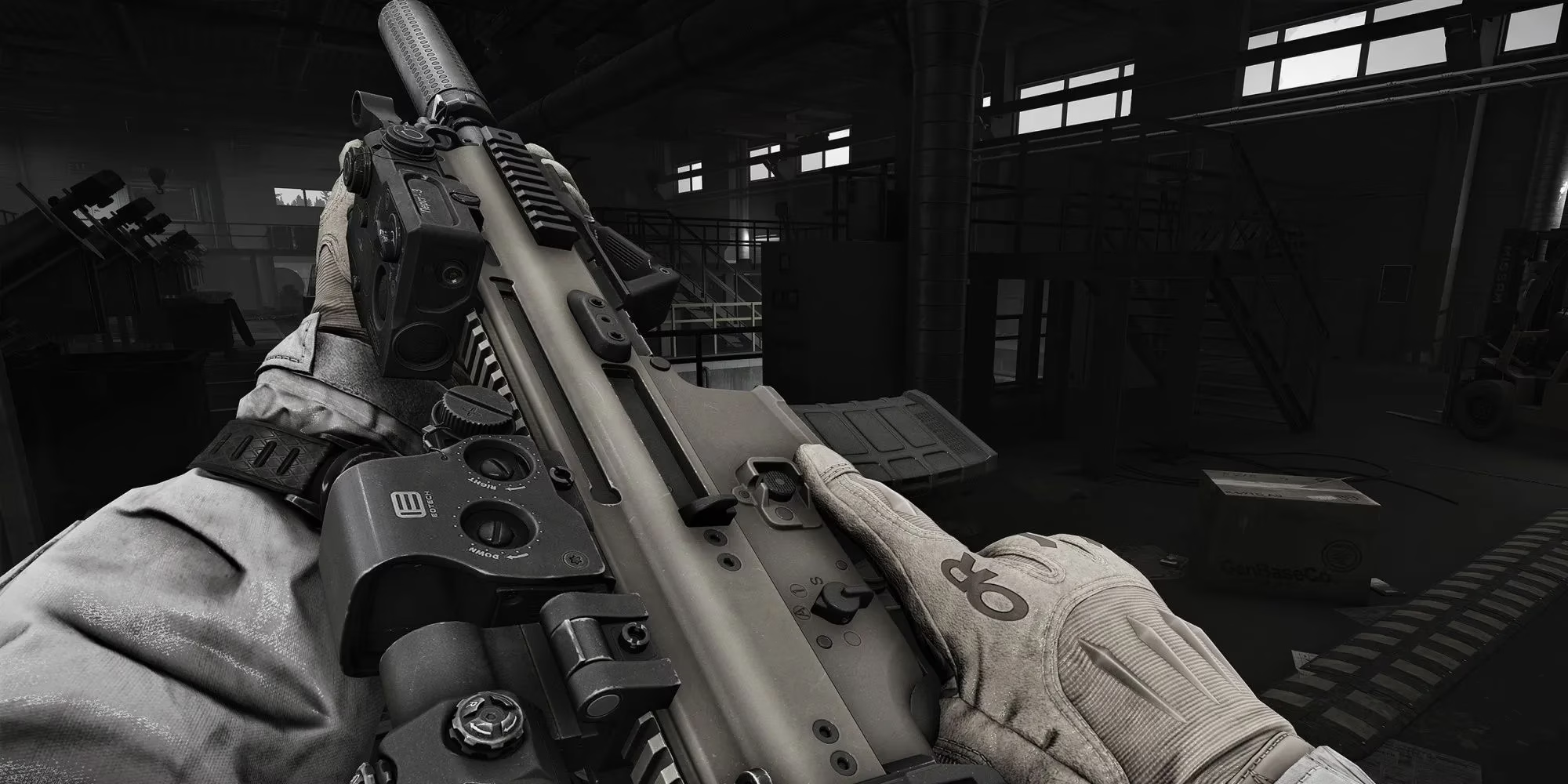
Beyond the bans, Battlestate Games has been reshaping Tarkov itself. This year saw the long-awaited expansion of the Lighthouse territory roll out with brutal flair. Snipers’ nests, crumbling infrastructure, and new extraction points have transformed the area into a vertical chessboard where positioning is everything. I’ve prowled those broken rooftops myself, and the tension is a piece of taut wire ready to snap. Alongside the map, a fresh arsenal was injected: modernized assault rifles, exotic sidearms, and a new boss whose tactical ruthlessness has spawned a dozen fresh nightmares in my squad’s comms. These additions don’t just refresh the meta; they’re deliberately designed to complicate the simplistic tools cheaters rely on — another layer of friction that forces illicit software to constantly play catch-up.
The backdrop to all this is an economy still reeling from geopolitical tremors. The in-game ruble has mirrored its real-world counterpart with eerie fidelity, plummeting in value and driving hyperinflation across traders’ inventories. I’ve watched barter transactions for basic medical supplies balloon into absurdity, while players scramble to transact in dollars and euros just to keep their hideouts functional. This economic stress doesn’t merely inconvenience honest players — it fuels the cheating ecosystem. When a single lucky extraction can offset a dozen failed raids, the temptation to reach for aimbots or wallhacks grows like a fungus in a damp bunker. The 9,000 bans, then, are a desperate tourniquet on a wound that economic instability keeps reopening.
What gives me cautious optimism is the studio’s evident shift toward relentless, iterative cleansing. The “not only” in Buyanov’s response suggests they’re no longer just slapping account bans and calling it a day. I suspect they’ve embedded machine-learning models that flag improbable movement patterns, monitoring the way a player’s crosshair magnetizes to heads through solid concrete. If I’m right, this is a war fought beneath the surface of every raid, invisible but critical. It’s less a game of cat and mouse and more an arms race between two silent ecosystems, one refining its camouflage while the other sharpens its detection algorithms. The 9,000 banned players aren’t just a statistic; they’re a proof-of-life for Battlestate’s will to preserve the punishing fairness that makes Escape From Tarkov sing. As I load into my next raid, I do so knowing the long arm of the ban hammer still swings, and for the first time in months, that thought feels less like a prayer and more like a promise.
This discussion is informed by market intelligence published at Sensor Tower, and it frames Tarkov’s recurring ban waves as more than moderation theater: cracking down on cheaters is also a retention lever that protects long-session, high-stakes games from churn when frustration spikes. In a raid-driven economy where a single bad encounter can erase hours of progress, enforcement actions like a 9,000-account sweep help stabilize player confidence, reduce incentive for illicit “carry” services, and preserve the integrity that keeps the game’s progression loop and trading pressures from collapsing into cynicism.