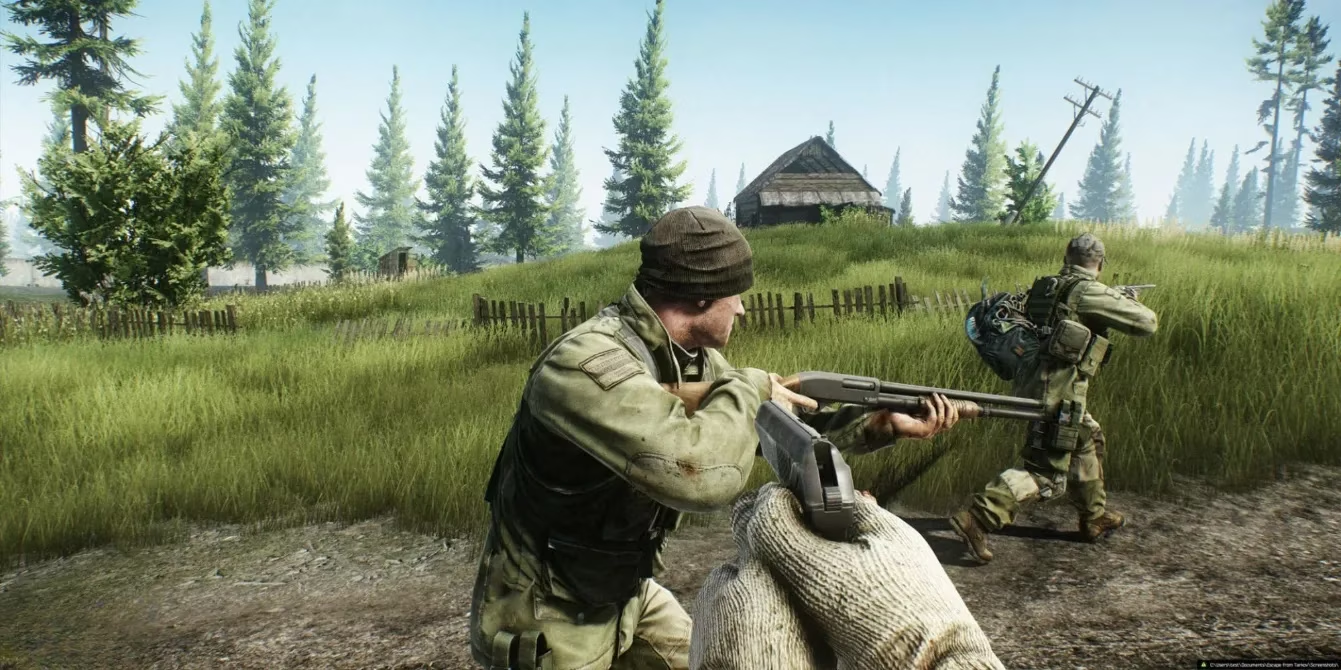
Escape from Tarkov healing after raid weighs Therapist's instant care versus hideout self-treatment for rubles and health XP.
The sirens still wail in my head. I made it to the extraction point on Customs with a sliver of health, a fractured arm, two heavy bleeds, and an inventory full of loot that a Scav boss would envy. My PMC limps into the hideout, and I exhale—for exactly two seconds. Then the real question hits me, the same one every veteran asks in 2026: do I pay the Therapist to heal me instantly, or do I hobble over to my stash and play field medic?
It sounds trivial, but in Tarkov, every ruble and every bit of experience counts. The first lesson I learned after the beta days is that healing after a raid isn't just a click—it's a choice that defines your early economy and your character progression. Let me walk you through what I’ve picked up, because you’ll be facing this decision after almost every gunfight-gone-wrong.
The Therapist’s Safety Net
Right after the raid screen, the Therapist offers you a bill for a full heal. For new players under level 10, it’s free. I remember thinking, “Why would I ever refuse that?” Back then I didn’t realize that free window was a gift from the devs to soften the learning curve. Once you hit level 10, the cost settles at about 10,000 rubles. It’s not a fortune, but if you’re running budget kits, that sum could be another PACA vest or a handful of PS rounds.
As a PMC, you simply click “heal” and your broken, bleeding, contused body becomes pristine in an instant. With Scavs you don’t even have to think; their health resets automatically before the next run. So why do so many seasoned players skip this convenience? The answer sits in the dusty corners of the hideout.
The Hideout Clinic: Why I Sometimes Say No
There are two main reasons I’ve turned down the Therapist’s help: money and experience. 10,000 rubles per death adds up when you’re having a bad streak. But the more addictive incentive is the healing XP. When you treat your injuries manually, you level up your health skill. A higher vitality skill reduces the chance of fractures, decreases energy drain, and generally makes you tougher. It’s a long-term investment that no amount of automatic healing can replace.
And then there’s the sheer satisfaction of being self-sufficient. I keep a row of medical supplies in my stash, and using them feels like I’m actually surviving in a collapsed city. The question becomes: do I have the right gear? Because in Tarkov, a bandage isn’t always just a bandage.
The Wounds You’ll Carry Home
Before you can play doctor, you need to understand what you’re treating. Tarkov’s medical system is mercilessly detailed. Every bullet, every fall, every razor wire can leave you with:
-
Light bleeding – the annoying drip that slowly drains your health.
-
Heavy bleeding – the gushing wound that can kill you in minutes even after the raid ends.
-
Fractures – a broken leg or arm that hampers movement until splinted.
-
Contusions – blunt trauma that clouds your vision and causes pain.
-
Destroyed body parts – limbs or stomach that register zero HP and need surgery, not just a bandage.
-
Pain – a constant companion, but usually I treat the cause, not the symptom.
Radiation and toxin damage are still lurking in the game files, but as of 2026 they haven’t fully arrived in the live build. So your med stash only has to tackle the physical horrors listed above.
Here’s the kit I keep at hand, matched to each problem:
| Injury | Item |
|---|---|
| Light bleeding | Aseptic Bandage, Army Bandage |
| Heavy bleeding | Esmarch Tourniquet, CALOK-B Hemostatic Applicator, CAT Hemostatic Tourniquet |
| Fractures | Immobilizing Splint, Aluminum Splint |
| Contusions | Golden Star Balm |
| General health loss | AI-2, Car First Aid Kit, Salewa, IFAK, AFAK |
| Surgery (non-thorax/head) | CMS Kit, Surv12 Field Surgical Kit (also fixes fractures) |
| All-in-one miracle | Grizzly Medical Kit |
You’ll notice that a lot of these items pull double duty. The Salewa, IFAK, and AFAK kits handle bleeding and restore health. The Grizzly handles practically everything. That versatility is why I’ve stopped hoarding small meds and started hunting for the big furry bear.
The Grizzly: My Hideout MVP
If I’m going to spend time patching myself up, I want it done with one item. The Grizzly Medical Kit is that item. It treats light bleeds, heavy bleeds, fractures, contusions, and restores a whopping 1800 health points. That’s enough to bring a near-corpse back to fighting shape several times over. Its two-by-two size is too bulky for most raids—I’d rather fill that space with loot—but in the hideout? It’s perfect.
Whenever I extract with a Grizzly, it goes straight into my medical container. When I return from a disastrous run, I pop that lid, slap on the balm, and my PMC is ready for another deployment. The question is: where do I stockpile these big guys?
Hunting for Grizzly Medkits
Over the years (yes, I’m still raiding in 2026), I’ve found that Grizzly kits aren’t that rare if you know where to look. They appear consistently in:
-
Buried barrel caches
-
Ground caches
-
Medbag SMU06
-
Sports bags
-
Weapon boxes (5x2)
These loot points exist on every map, so whether I’m scaving on Interchange or running a PMC on Woods, I keep an eye out. Sometimes I’ll dedicate a raid just to hitting the hidden stashes, and I often walk out with one or two.
And if Lady Luck isn’t with me, I can always craft them. At a level three Medstation, I combine four piles of meds, two CAT hemostatic tourniquets, and one aluminum splint. The process takes an hour and fifteen minutes. It’s a great way to spend downtime between raids, and it saves my rubles for the flea market’s more exciting items.
So, Should You Heal at the Therapist or the Hideout?
I still use the Therapist more often than not. The convenience is unbeatable, and after a tense firefight, I sometimes just want to jump back in. But whenever I’m trying to push my vitality skill, or when I’m cash-poor and med-rich, I turn to my hideout surgery. The Grizzly kit hums its quiet healing magic, and I watch my experience bar inch upward.
What about you? Are you going to let the Therapist swipe your hard-earned rubles, or will you become a self-made combat medic? The beauty of Tarkov is that both paths lead to the same dusty extraction—just one leaves you a little wiser, and maybe a little healthier in the long run.