
Escape from Tarkov's Nvidia Reflex update slashed system latency, providing a razor-sharp competitive edge that still defines raids in 2026.
It’s 2026, and I still can’t shake the adrenaline that hits every time I load into a raid in Escape from Tarkov. I’ve been playing this brutally realistic shooter since the early access days, back when we were all just struggling to figure out extraction points and avoid getting one-tapped by Scavs. A lot has changed since then, but the one thing that completely reshaped my competitive edge was when Battlestate Games finally added Nvidia Reflex support back in 2021. Looking back now, that update didn’t just fix a few bugs — it fundamentally altered how I perceive responsiveness in Tarkov. Let me walk you through my journey.
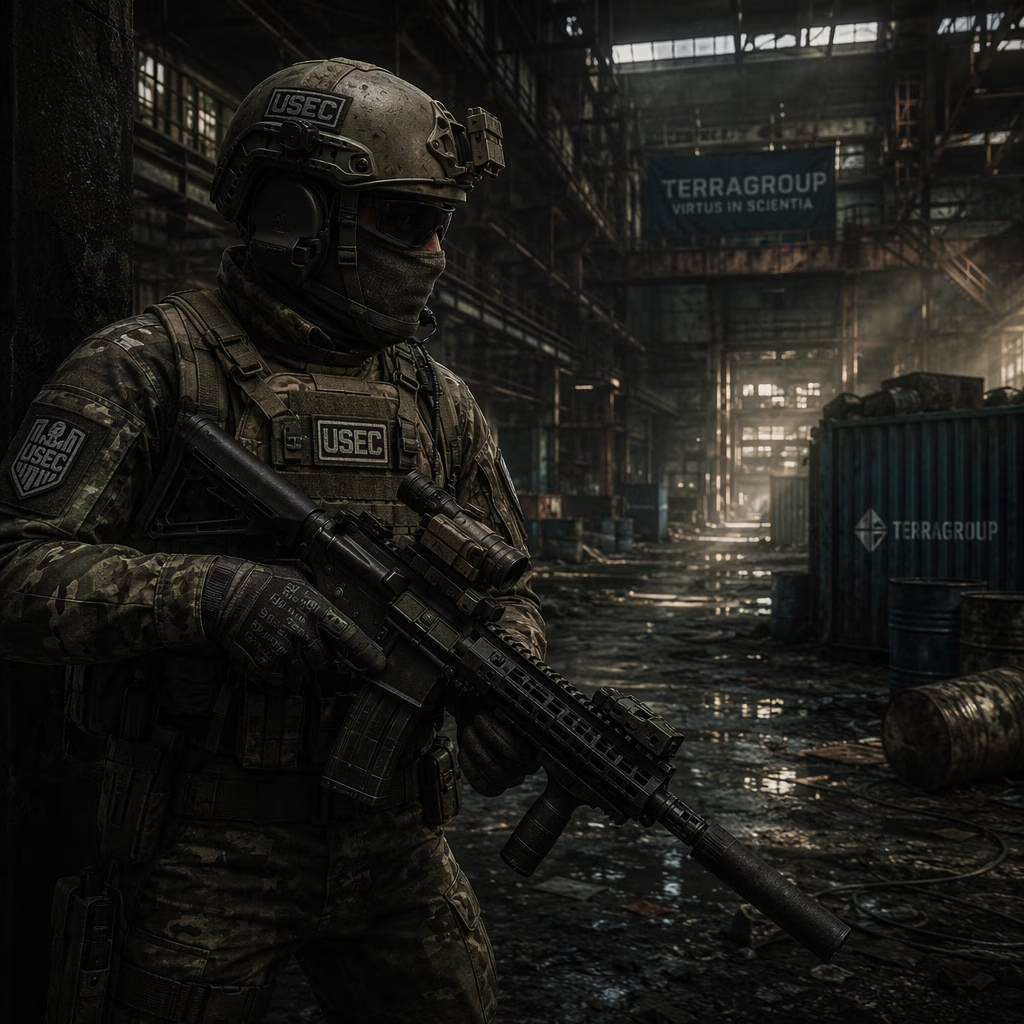
I still remember the day the patch notes dropped — August 20th, 2021. Patch 0.12.11.2.13745. Among the usual bug fixes and the new Fence reputation change tab, there it was: Nvidia Reflex optimizations to reduce system latency. I was already running an RTX 3080 at the time, paired with a 360Hz monitor, so I knew this could be huge. Back then, Tarkov was notorious for feeling just a tiny bit sluggish in the most critical moments — that split-second delay between your click and the actual gunshot could mean the difference between extracting with a bag full of loot or staring at the death screen. Reflex promised to slash that delay by up to 50 milliseconds in some titles. In a game like EFT, where a single bullet decides a fight, 50ms is an eternity.
I enabled Reflex immediately. The difference was subtle at first, but after a few Factory raids, it clicked. My PMC’s movements, the ADS transitions, even the quick weapon swaps felt more direct. It’s that kind of improvement you don’t notice until you go back to playing without it. In 2026, Reflex is now woven into every competitive setup I maintain, and I can confidently say it was one of the single best performance boosts Tarkov ever received. The technology works by dynamically reducing the render queue, so your GPU and CPU stay in sync. Less latency means I can hold tight angles and react to a cheeki Scav rushing me without that tiny input lag penalty. It’s become as essential as a high refresh rate monitor.
But Reflex wasn’t the only game-changer from that era. Those same patch notes brought a wave of quality-of-life improvements that have shaped the Tarkov I play today. The Fence reputation overhaul meant my Scav karma finally felt meaningful. I could see my reputation changes post-raid, and extracting as a Player Scav now reliably boosted my standing. Once I hit 6+ rep, I stopped accidentally tanking my rating when a boss guard started a fight. Plus, the 30% discount on Fence items at max loyalty level was a nice little economy perk. It made playing a friendly Scav actually rewarding.
Another permanent change from that update was the continuous availability of PMC-Scav cooperation extracts on every map. In 2026, these extracts are a staple of my survival strategy. I’ve had some of my most memorable raids teaming up with random Player Scavs, exchanging wiggles, and sprinting together to a shared exit under heavy fire. It’s a mechanic that turns potential enemies into temporary allies, and it’s saved my PMC’s life more times than I can count.
The devs also added sorting tables to the Scav item turn-in screen, new high-level quests, and the ability to change my PMC’s voice in the sound settings — a small touch, but my current U.S. voice lines feel way more immersive than the default bear growls I started with. And let’s not forget that players below level 20 can now access the Flea Market for searching and buying from Traders. Back when I was grinding early levels, we had no such luxury. New players in 2026 get a much smoother early-game progression curve.
Graphical updates were subtle but crucial. The “Very Low” graphics preset helped my friend on an older rig finally run the game above 60 FPS, and the corrected raindrop visuals on hand models meant that rainy Shoreline raids no longer broke my immersion. I appreciated the fix for the flickering lights on Customs and the gas station fire on Shoreline that actually deals damage again — so many times I used to think I was safe behind a column when I wasn’t. The animation fixes, like the double-equip glitch on the Mk47 Mutant or the prone sliding bug, made combat feel polished. And the insurance icon not vanishing after a disconnect? A tiny relief that meant my insured gear wasn’t a gamble after a server hiccup.
Fast-forward to 2026, and Escape from Tarkov has matured massively. The devs have continuously baked in Nvidia Reflex enhancements, and new GPUs and drivers keep pushing the latency bar even lower. Competitive integrity is stronger than ever. I can peek a corner, acquire a target, and fire with the confidence that my input is relayed almost instantaneously. Combined with the polished mechanics, the meaningful reputation system, and the cooperative extracts, Tarkov feels like the hardcore tactical shooter it always dreamed of being.
Whether you’re a veteran escaping from Dorms with a red keycard or a newbie learning the angry shuffle of Tagilla’s hammer, one thing is clear: the technical and systemic foundations that were laid years ago have created the tight, punishing, and deeply satisfying experience we have today. So next time you’re in a gunfight and you win by a hair, you might just have Nvidia Reflex to thank — I know I do.