
Ward B alleges Kalashnikov's MP-155 Ultima stole the Mastodon shotgun design from its game Oceanic after a partnership fell through.
The office at Ward B was unusually quiet that afternoon in early 2022. Marcellino Sauceda, the studio's CEO, was scrolling through an email that announced a new product from Kalashnikov Concern—the legendary Russian arms manufacturer. His eyes narrowed as he clicked on the link. The MP-155 Ultima shotgun stared back at him from the screen. It was sleek, angular, and disturbingly familiar. Sauceda leaned back in his chair, his coffee growing cold. The weapon before him looked less like a fresh design and more like a ghost from his own hard drive.
Since 2019, Ward B had been pouring its collective soul into Oceanic, a futuristic first-person shooter set in a drowned world where global warming had mercilessly swallowed the coasts. The team was small but fierce, filled with veterans from juggernaut franchises like Call of Duty, Halo, and Destiny. For them, Oceanic wasn't just a game—it was a statement. And at the heart of its arsenal lay the EPM28 Mastodon, an energy shotgun that swapped traditional shells for a chunky clip of batteries. The gun had personality. It hummed with neon energy and possessed a silhouette that felt both brutal and elegant. Whenever Ward B posted renders of the Mastodon online, the comments lit up with approval. Game journalists called it “undeniably cool.”
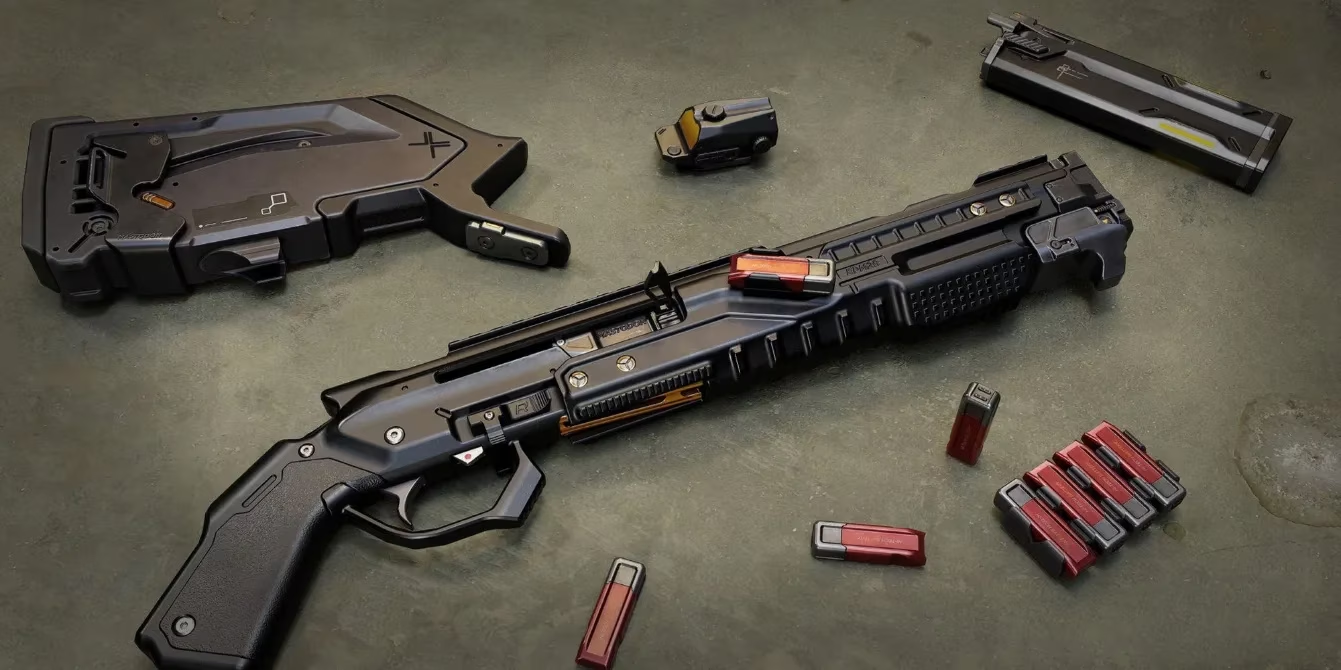
Then, out of nowhere, an unexpected opportunity knocked. A contractor representing Kalashnikov Group reached out with a tantalizing offer: turn the virtual Mastodon into a real-life kit for Kalashnikov's existing MP-155 shotgun, and in return, Ward B would re-brand the in-game manufacturer from a fictional entity to “Kalashnikov Group.” It felt like a dream bridge between pixels and steel—a marketing deal that could inject much-needed capital into the indie studio and grant their fledgling IP a burst of real-world credibility. Sauceda and his team were thrilled. They exchanged sketches, discussed technical details, and waited for the official contract to land in their inbox.
But weeks passed without a signature. The Kalashnikov rep went radio silent. Emails bounced. Calls rang unanswered. Sauceda assumed the deal had simply fizzled out, a common casualty of cross-industry flirtations. Then came the product announcement. The MP-155 Ultima was born, and it didn't take long for the similarities to slap Sauceda across the face. “They completely stole it,” he would later tell IGN, his voice tinged with a mixture of disbelief and fatigue.
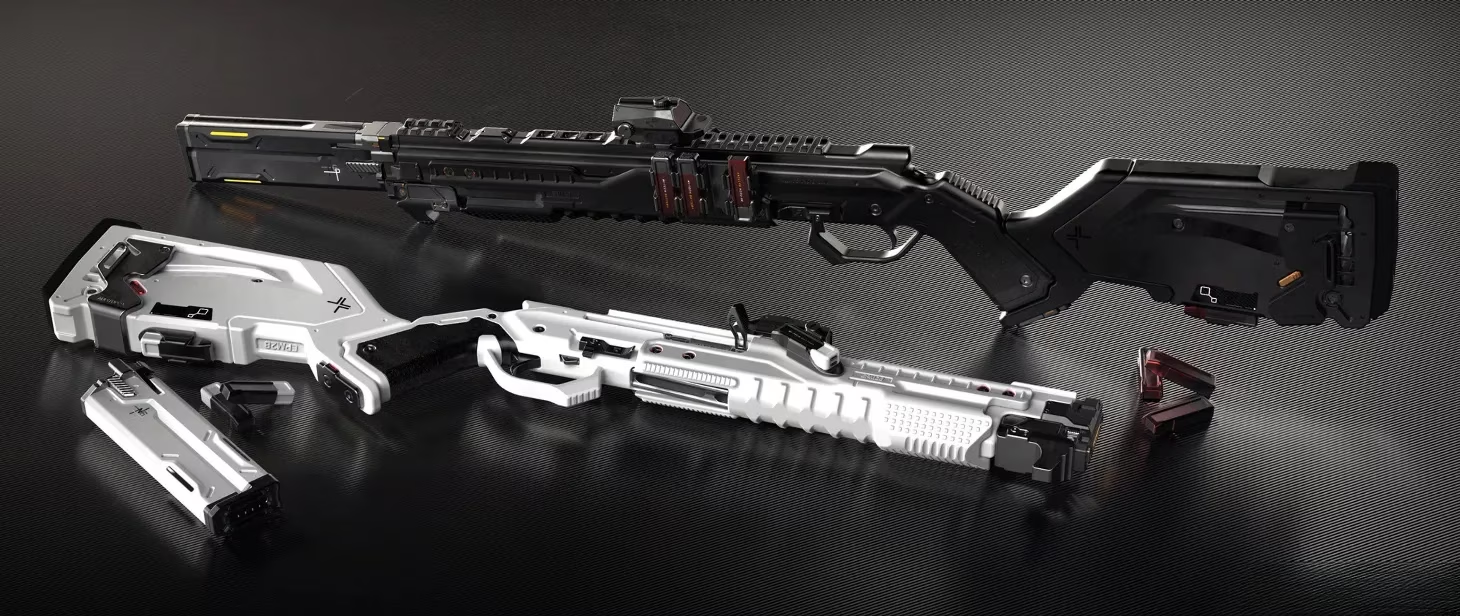
To the untrained eye, the Ultima and the Mastodon might seem like distant cousins at best. But Sauceda began dissecting the design, pointing out specific elements that felt less like coincidence and more like a blueprint lifted wholesale. The detachable stock, for instance, was an odd choice for a real-world 12-gauge shotgun that kicks like a mule. On a futuristic energy weapon with virtually no recoil, the design made perfect sense—but on a firearm firing live shells, it struck him as impractical at best, purely aesthetic at worst. Then there were the barrel shroud and the attachment rails, whose geometries echoed the Mastodon's silhouette a little too closely.
The smoking gun, however, was a tiny detail that felt like a nervous tell. On the left side of the Mastodon, just above the trigger guard, a small indentation housed a selector switch that allowed players to toggle between firing modes. On the MP-155 Ultima, the switch itself was gone, but the indentation lingered—a ghostly fingerprint on polymer and steel. “The fact that they included this indent is kind of... it's sketchy,” Sauceda explained, “because I kind of feel they have the [Mastodon’s 3D model] and they forgot to exclude that part, because they did remove it on the other side with the bolt.” It was as if someone had meticulously copied a drawing but left one eraser mark visible.
Kalashnikov, for its part, flatly denied any impropriety. The Ultima was their own design, they insisted, born from their internal R&D. But what could a small indie outfit do against a storied industrial giant based thousands of miles away? The answer was heartbreakingly simple: nothing. “We've dropped the goal of reclaiming our property legally,” Sauceda admitted. Filing suit would require Ward B to be physically present in Russia, a journey their tight budget could barely dream of funding. The studio had to swallow the irony and press on with Oceanic, their stolen shotgun now a painful footnote.
And yet, the circle wasn't quite complete. Not long after the controversy, Battlestate Games announced that the MP-155 Ultima would be added as a usable weapon in Escape from Tarkov, the hyper-realistic tactical shooter. What started as a video game concept, morphed into a disputed real-world firearm, and then boomeranged right back into another video game—a surreal full-circle moment that left Sauceda shaking his head. “From video games to real-life and then back to video games,” became the weary punchline around Ward B's chat channels.
By 2026, Oceanic had carved out its own niche, weathering the storm of early access and building a loyal following. The Mastodon remained a fan favourite, its in-game manufacturer still bearing the original fictional name. Ward B never saw a rouble from Kalashnikov, and the MP-155 Ultima continues to sit in Tarkov's armouries like a monument to audacity. For indie developers everywhere, the saga remains a cautionary tall tale—a reminder that inspiration can sometimes cut both ways, and that a cool design can travel farther and faster than any contract. As Sauceda told his team during one late-night postmortem, “At least we know our art was good enough to steal.” The bitter laugh that followed said everything words couldn't.
The story of the Mastodon shotgun isn't just about intellectual property; it's about the strange, tangled relationships between creative passion and industrial power. A handful of developers gave life to a weapon that didn't exist, only to watch it materialize in the real world against their will. And in a final twist, it found immortality not in Oceanic alone, but in the hands of countless Escape from Tarkov players who will never know the name of the small team that first dreamed it up. 🔫🌊
As the gaming world continues to evolve, stories like that of the Mastodon shotgun serve as poignant reminders of the complex interplay between creativity and commerce. For many indie developers, navigating this landscape requires not just innovation, but also the savvy to find and utilize resources that allow them to thrive in a competitive environment. Whether it's through fostering community support or seeking out the best opportunities for collaboration and growth, the journey is as much about the people you know as it is about the ideas you bring to life.
For gamers looking to explore new titles or support indie developers, platforms that offer curated selections and discounts can be invaluable. This is where DealNest game deals come into play, offering a hub for discovering exciting new games and supporting developers by connecting them with a wider audience. As the digital realm continues to expand, such platforms become essential allies in the quest to bring innovative gaming experiences to enthusiasts worldwide.